Tips and information
What’s Your Dosha?
If you’ve been to Jo’s class regularly, you have probably noticed that she’s always got something new she’s learned and wants to share. She lives her belief that every yoga practice is a 3-D work of art, like a live concert that will never happen exactly in the same way with the same people in the same place again. Jo embraces new experiences and teachings, and her students benefit.
Jo recently attended a weekend retreat in Boone to study with Medha Garud, who combines her work as a physical therapist, yoga therapist, and Ayurvedic practitioner at The Art of Living Retreat Center. She chose this retreat so she could study with a teacher from India in a holistic environment steeped in Indian culture. And spending time in the beautiful Blue Ridge Mountains appealed to her too! She travels to Boone several times a year to hike and join the Native Plant Society for outings and lectures.

The Inseparable Sisters: Yoga and Ayurveda
Jo returned from her retreat with fresh insight into her yoga practice, having learned about Ayurveda. Simply put, Ayurveda is the science behind the practice of yoga. Understanding one requires understanding the other. While any body can benefit from the physical motions of a yoga practice, moving through the asanas involves a deeper sense, what Ayurveda calls a natural intelligence. Incorporating this natural intelligence can bring about a more fulfilling outcome.
Ayurvedic philosophy holds that we each have a constitutional makeup that contains various amounts of the five elements: space, air, fire, water, and earth. Your dosha determines how you might best approach your diet and lifestyle. Find out which dosha best matches your constitution with this quiz. Once you know your dosha, you can modify the foods that you eat and the asanas that you incorporate into your yoga practice.
Having learned that she’s a pitta-kapha (more on the pitta side), Jo learned how to modify her lifestyle to accomodate her natural energy. She adjusts a little each week, taking baby steps, saying, “It’s a lot of change, and I want to set myself up for success.”
Success indeed! Over the course of the weekend, she reached the 500 hour milestone in her yoga teacher training. The RYT 500 designation from the Yoga Alliance is a significant step up for Jo, so be sure to congratulate her on this happy event (although you may not see her until the end of summer–Jo will be spending the next 11 weeks at the YMCA’s Camp Weaver).
Breathing is Enough
As the seasons change and chilly weather tempts us to hibernate, while the the world is tempting us to go go go, it is important to listen to our bodies. This is the natural time of year to slow down, as we slip on our cozy sweaters and fuzzy socks.
Here are a few things we can consider as we focus our practice and set our intentions:
1. Being enough. When you feel the pressure to do more, be more, plan more, spend more, and go more, respect your limits and decide that you are enough. Your body is enough. Slow down, appreciate the current situation, and be content.
2. Breathing. Our lungs are designed to carry oxygen to our blood stream, and with each deep inhale you bring a fresh supply. Breathing deeply and slowly brings the calm that you need in the midst of the rush of the holiday season.
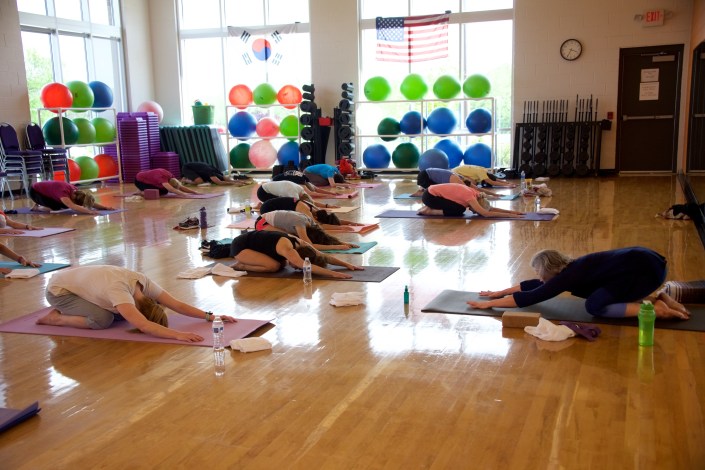
3. Modifications. Learn to give yourself help when you need it. Raise the level of the earth with a block. Stabilize your joint with a strap. Rest in child’s pose when you need to. Self-care begins with knowing your limits.
Over the course of the next few months, remember to slow down, breathe, and take care of yourself.
Now is the Time to Begin a Home Yoga Practice
Having trouble getting your schedule to line up to available yoga classes? Stuck at home in a snowstorm? Easy solution: begin a home yoga practice. Building a home yoga practice is something many yogis crave but just can’t seem to get off the ground.
Here are some tips for creating the space in your home and schedule for a daily practice.
1. Locate a place in your home to practice. You’ll want enough floor space for your mat plus a few feet extra in each direction for your arms and legs to stretch out. Play some music to inspire movement, and if you can, close the door to reduce distractions.
Move furniture if you have to, and dedicate storage space nearby to store your mat and any props that you use. Consider a location near a sturdy cushioned chair, a couch, or a blank span of wall to use for balance poses and inversions. If you have warm sunny weather, try practicing outside on a deck or porch.
2. Find a 10-minute time slot to begin. You can expand it later, but all it takes is a few minutes each day for your body to respond to the rhythm of a regular practice. Attach it to something that is already in your regular routine, such as your shower in the morning or bath in the evening. After a few days, your body will begin to crave the stretches and the energy created by the asanas. Once you reach this point, sticking with the routine will be a piece of cake!
3. While you can find many good instructional videos, books, and apps that will lead you through a sequence of poses, you can also simply begin with a sun salutation and see what happens.
A well-balanced practice will work the front and back as well as both sides, and it will include the following:
- Poses to warm your muscles
- At least one balance pose
- A spinal twist
- An inversion
- A back-bending pose
- A cool-down pose
Chances are, as you begin to move your body you’ll naturally flow from pose to pose, moving with your breath. With the right intentions and focus, you’ll soon discover the richness of supplementing studio classes with a home practice.
 Jo Walker Yoga